Not good yet. Getting better.
These are all my paintings, the wobbly ones included. Muddy purples, lopsided leaves, a cauliflower where the sky should be. They're here with honest feedback on each from Claude, Anthropic's AI, because the point is to keep going, not to look good.
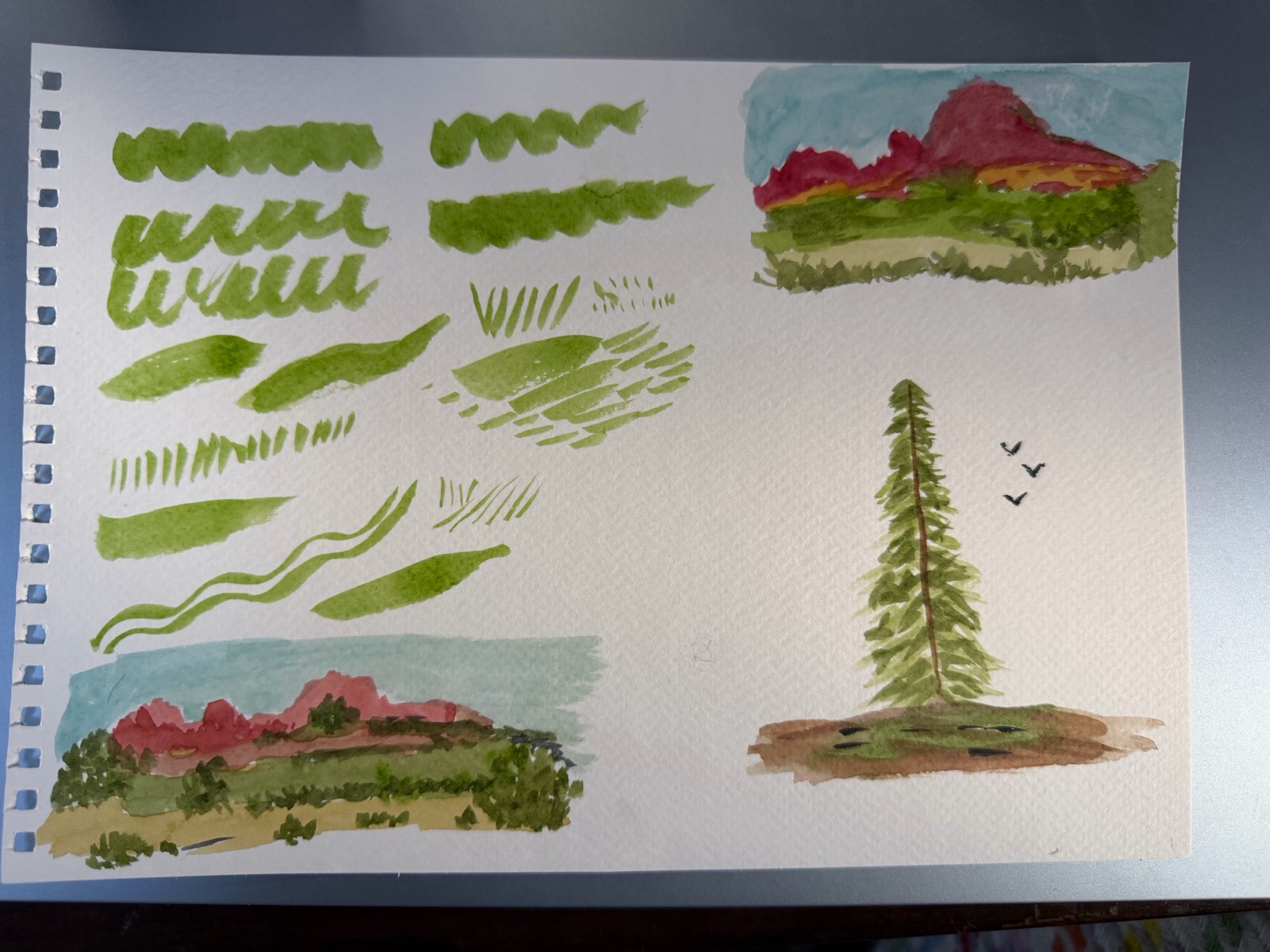
Lesson 1: Holding and loading the brush
The green squiggles and commas keep the same load from start to finish, with no dry gaps or puddles. The two little landscapes have a streaky sky and some backruns where the crimson hills met the wet green.
Dark trees against a pale field give the landscapes some depth, but the hills and sky sit in the same mid value.
Varied greens on purpose in the landscapes (olive, yellow-green, a dark green for the trees), all clean. The crimson hills are straight from the pan.
The hatching and the fir-tree needles are crisp where they should be. In the landscapes, crimson ran into green where it wasn't planned.
The fir tree is the star: quick tapering strokes that get shorter towards the top, so it reads as a tree straight away. The tapered commas show the grip is working.
The landscapes are stacked in equal bands of similar width, so nothing leads the eye.
Do the press-and-lift lesson next. Your fir-tree needles show you've already got the start of it.
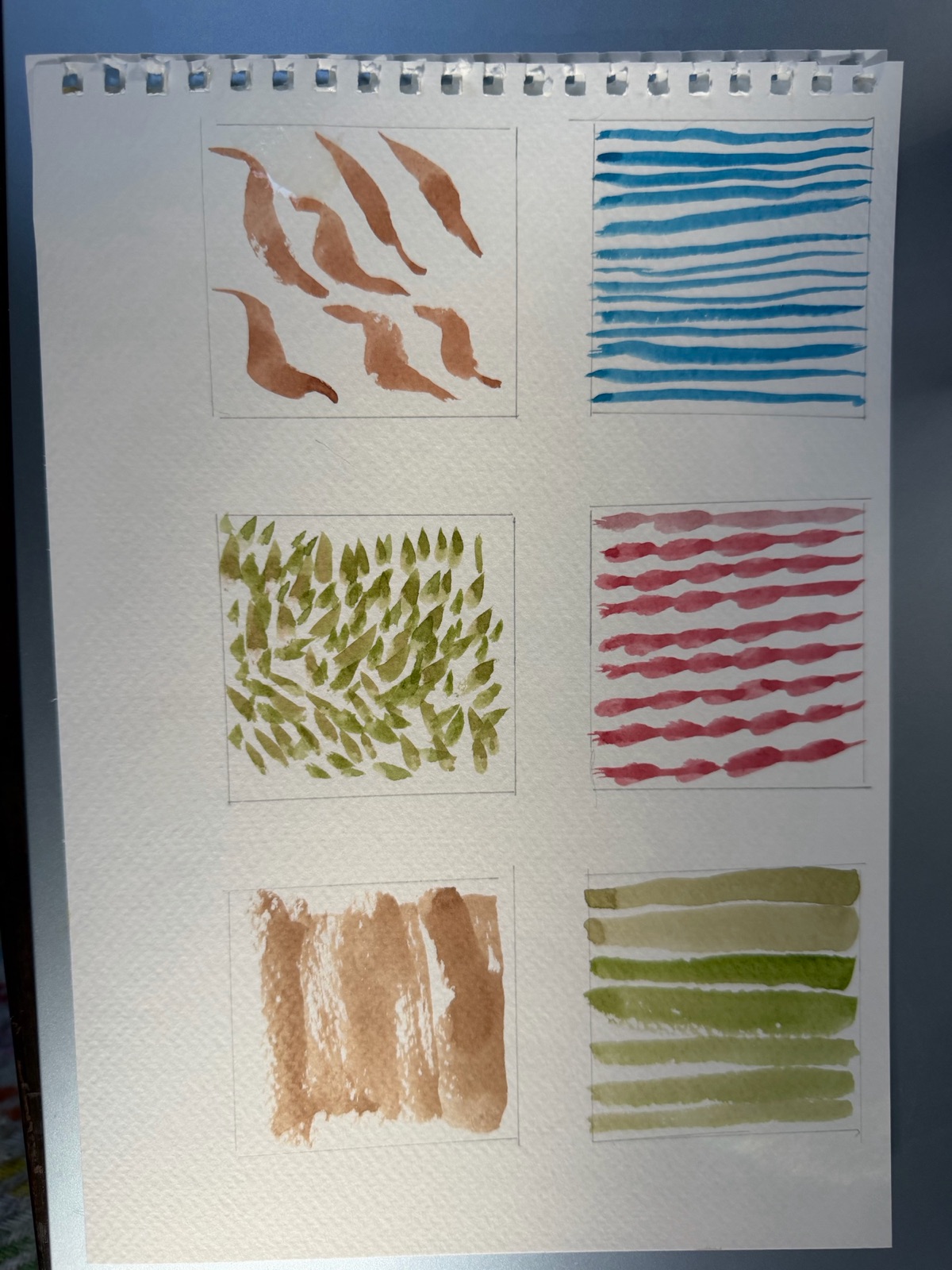
Lesson 2: Thin to thick: brush control drills
The blue lines are the best brush control so far: about fifteen long strokes of an even width. The olive bands each have a dark blob at the left where the brush touched down too wet, and the brown comma box has a pale bloom in the top-left corner.
Crisp edges throughout, and the dry-brush box has broken, sparkly edges on purpose.
The red thin-thick-thin lines pulse in a steady rhythm, and the green leaf box is full of consistent press-and-lift leaves turned in different directions.
Before each stroke, touch the brush on a tissue so it starts with a bead of paint rather than a drip. That cures the blob at the start of each olive band.
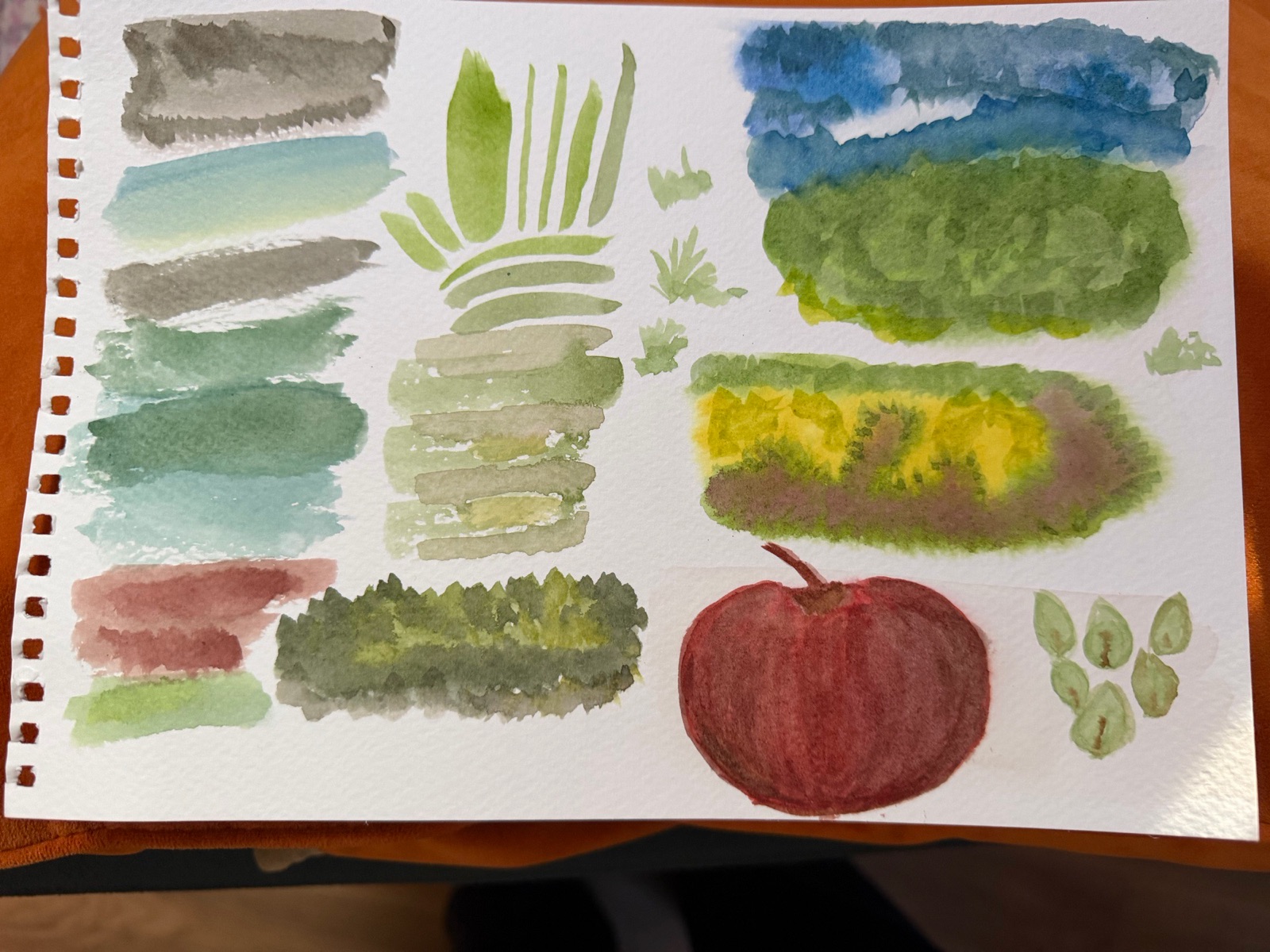
Lesson 3: Wet-on-wet vs wet-on-dry
Wet-on-dry strokes are crisp, but the big wet-on-wet patches are full of cauliflower blooms and backruns. (Lowered 3→2 after a blind second opinion, 14 Oct.)
Good greens again: olive, sage, yellow-green and grey-green, plus a convincing grey. The middle of the yellow-brown block went muddy where three colours met while wet; two at a time stays cleaner.
Both kinds on one sheet, on purpose: crisp-edged strokes on dry paper (top row, the green stripes) and soft, feathered blends where colour went into wet (the dark green block with yellow dropped in; the yellow-brown-green block). That's the lesson landed.
The apple is a confident, rounded shape with a lively stalk; the small seed-leaves are neat and consistent.
Do the shine test on purpose: wet a square, drop colour in at shiny, at satin and at matt, and label each. You'll see exactly when the soft blend turns into a cauliflower.
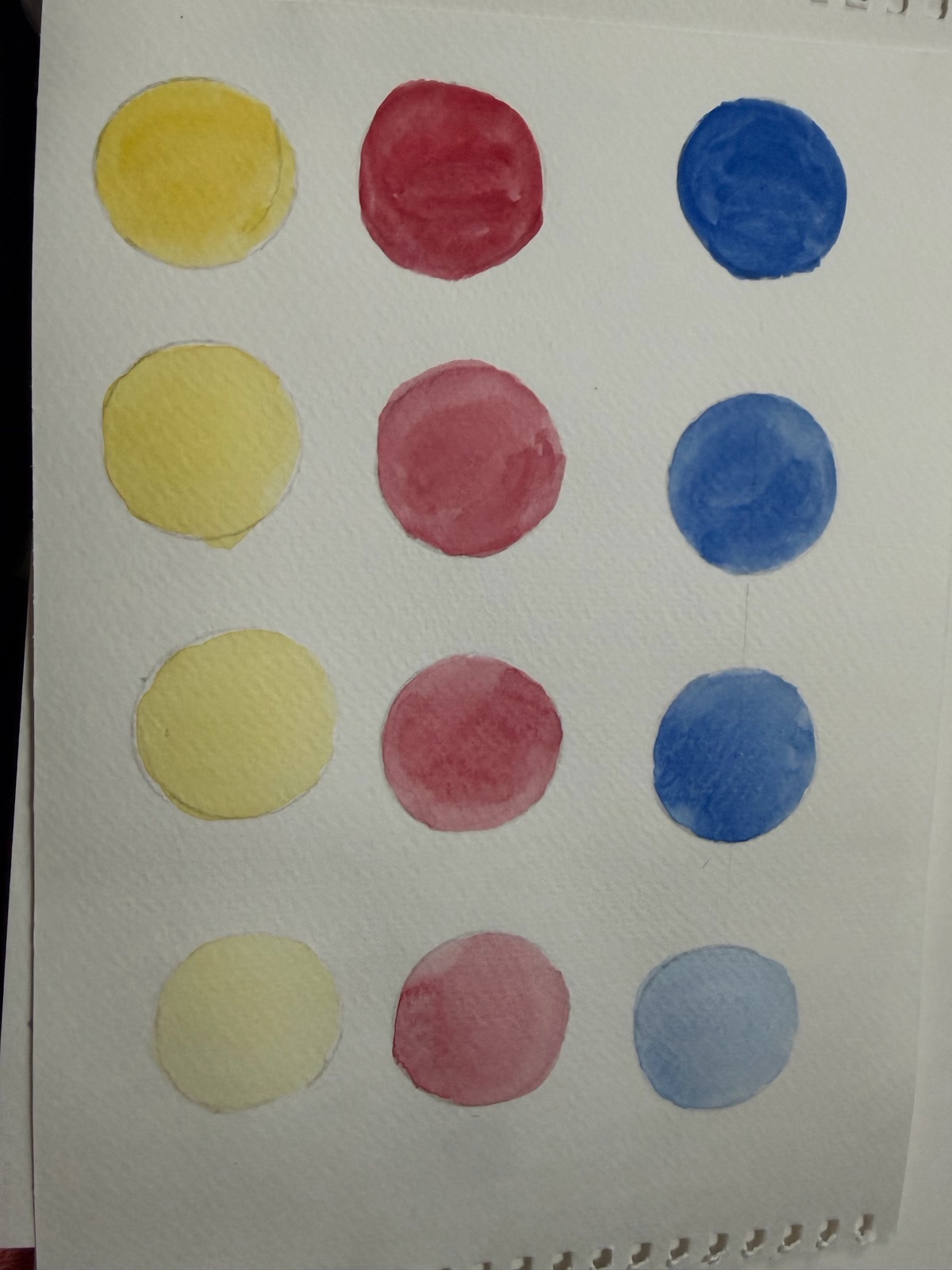
Lesson 1: paint-to-water circles (yellow, red, blue)
Round, confident shapes with mostly even fills. Two yellows have a second hard ring where a wet edge was reworked, and the strongest red shows streaky brush marks.
Four steps planned, but the middle steps sit too close together (red rows 2 and 3, blue rows 1 to 3). Only the palest step clearly separates.
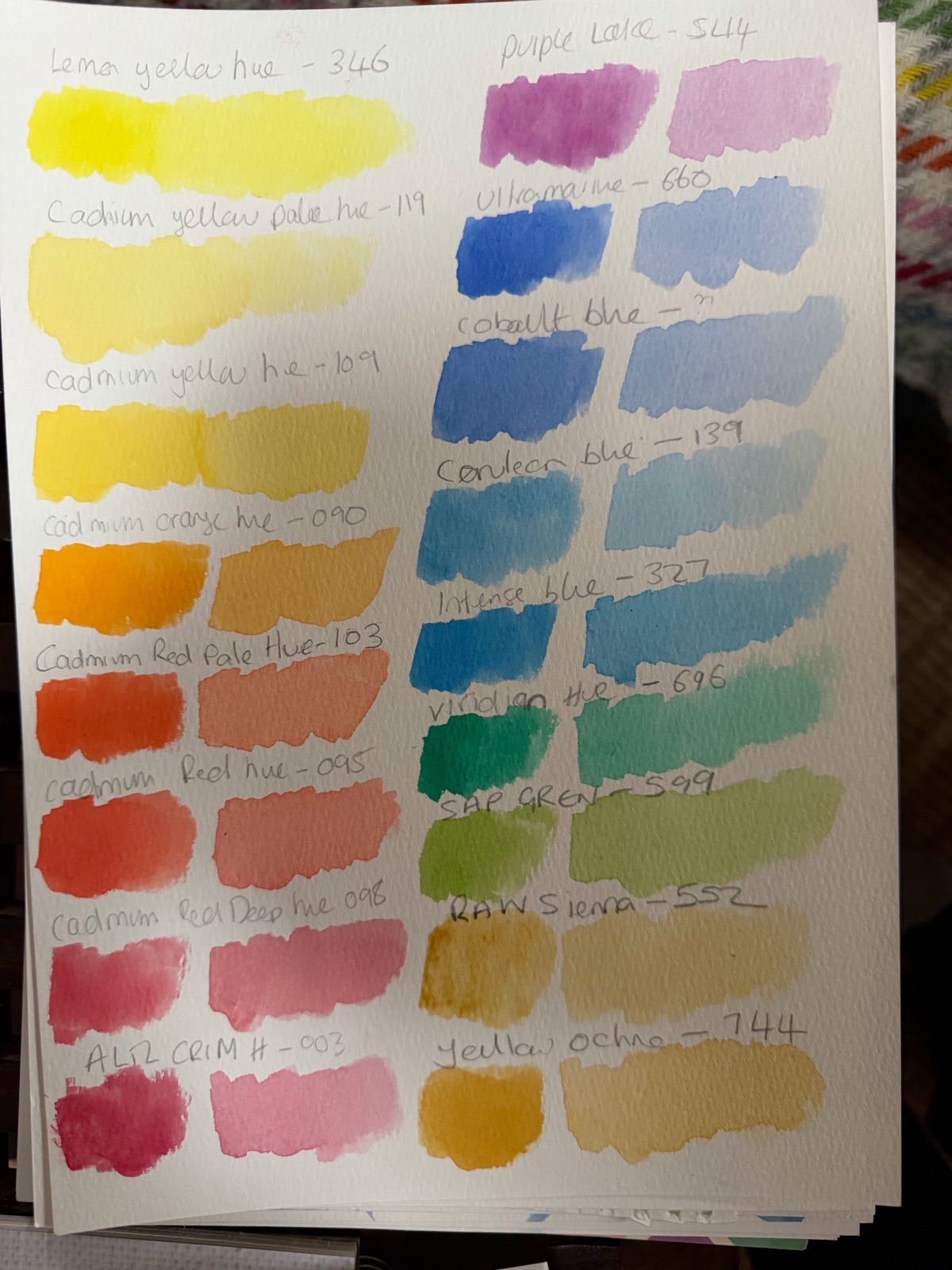
Paint chart: new set, page 1 (yellows to earths)
Every colour has a full-strength and a diluted swatch, and most masstones are even. The diluted swatches are lovely and clean.
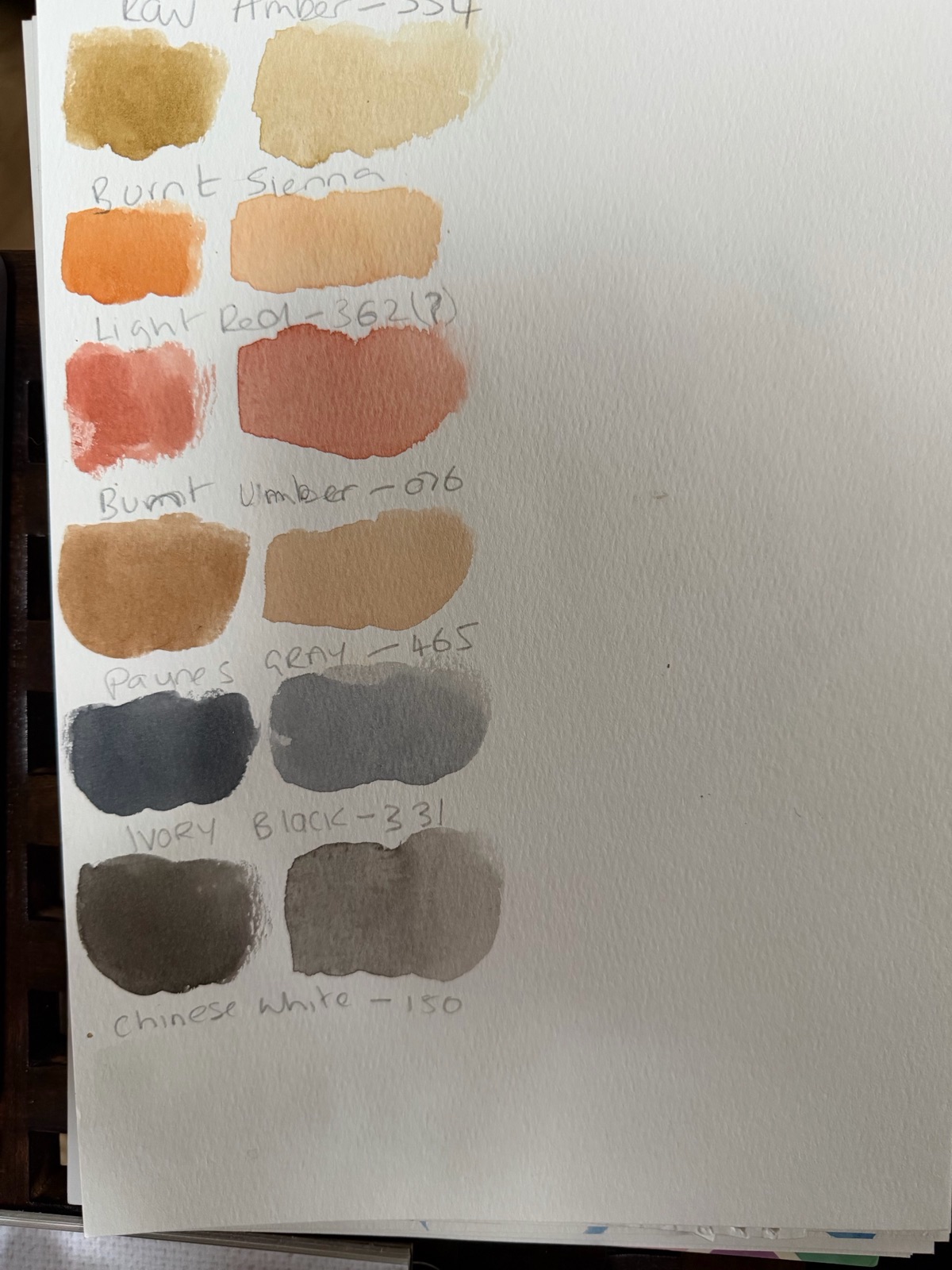
Paint chart: new set, page 2 (earths, greys, black)
Even earth swatches. The Light Red masstone runs dry (dry-brush streaks at the right), and Payne's Gray has a small backrun on its left.
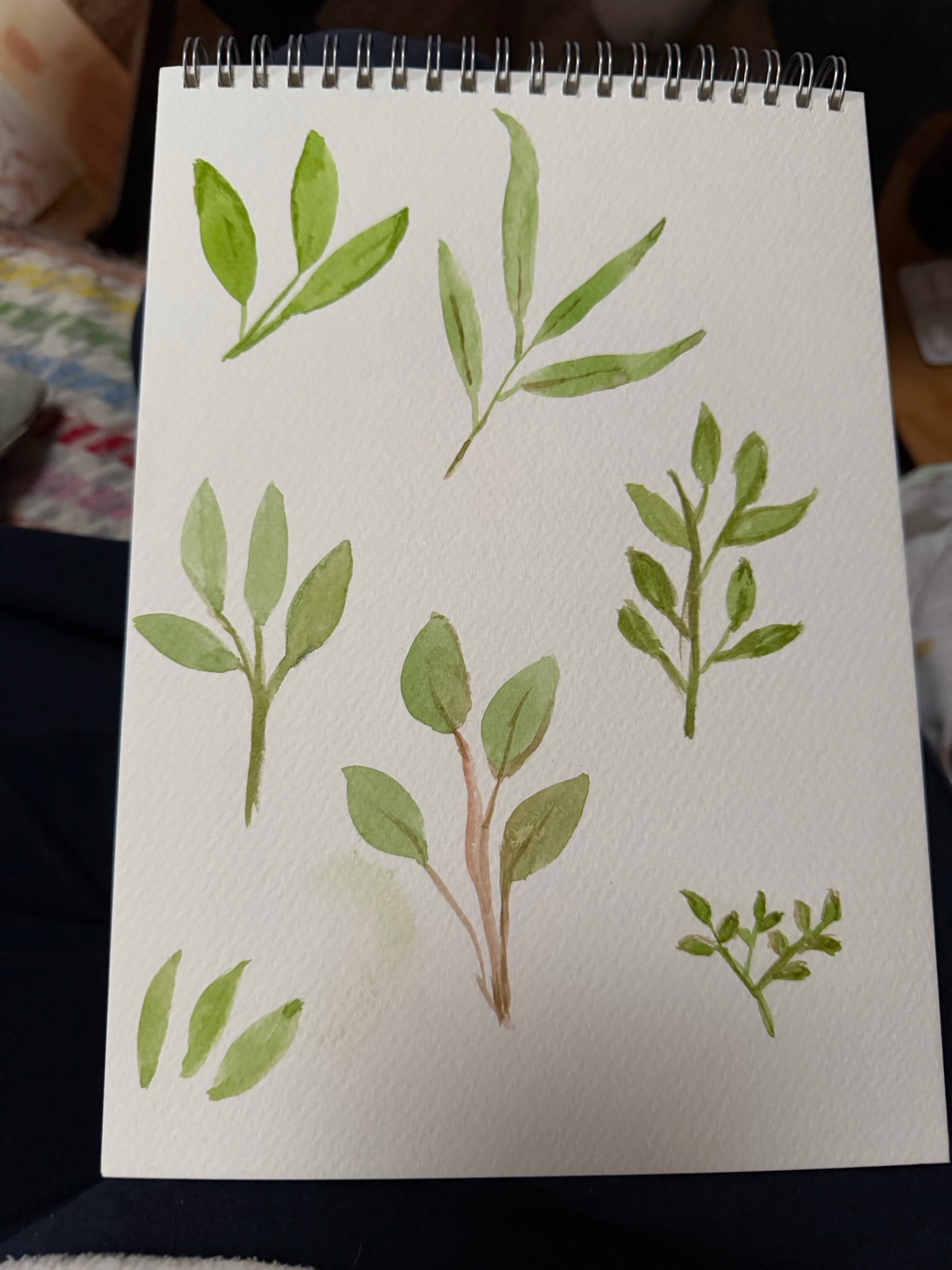
Eight simple leaf shapes
Even, clean fills in almost every leaf. Some leaves have a darker rim where paint pooled at the edge as it dried, which is a sign of a very wet brush finishing the shape.
Real variety on purpose: yellow-greens, olive and grey-greens, and a warm brown for the stems. Not one green for everything.
Veins dropped in while the leaf was still damp, so they're soft (top-middle sprig). The first time edges have been varied deliberately.
Readable, varied leaf shapes with natural curves, and stems that branch instead of standing stiffly upright.
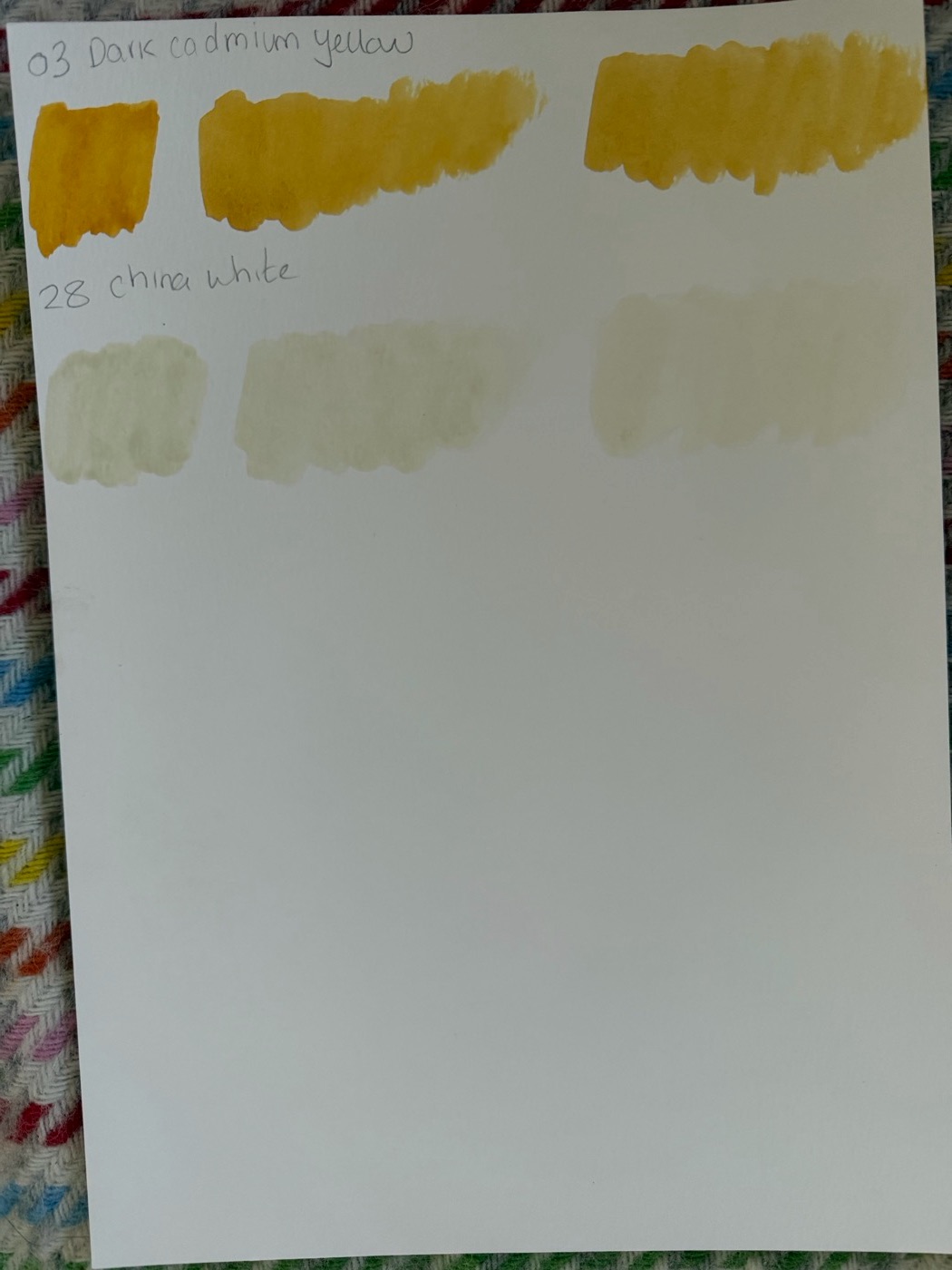
Swatches: Dark Cadmium Yellow, China White
The yellow tint shows clear brush-stroke ridges. China White dries chalky.
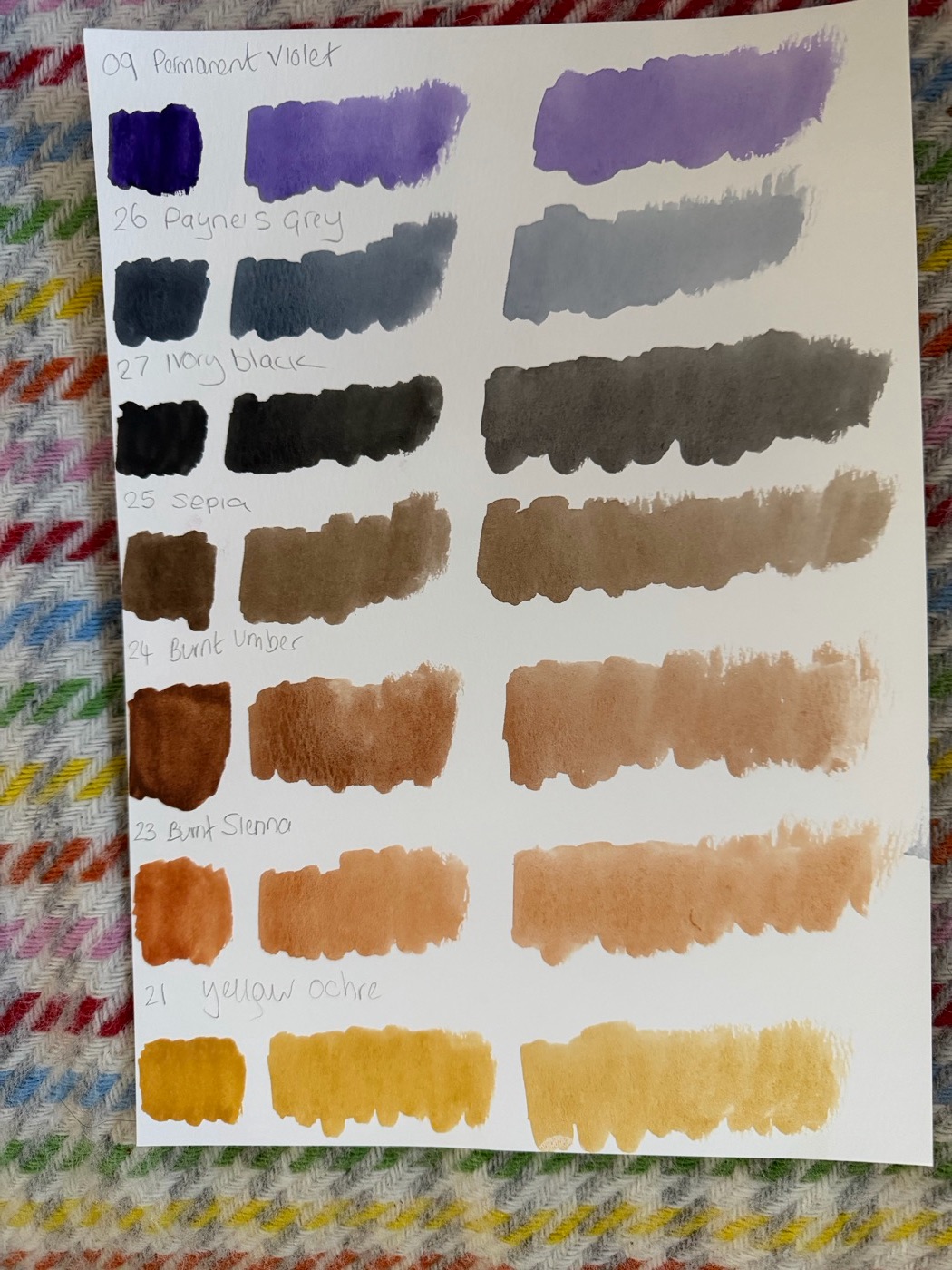
Swatches: violet, greys, earths
Burnt Umber, Burnt Sienna and Sepia tints streak and have ragged 'finger' ends: the brush ran dry partway.
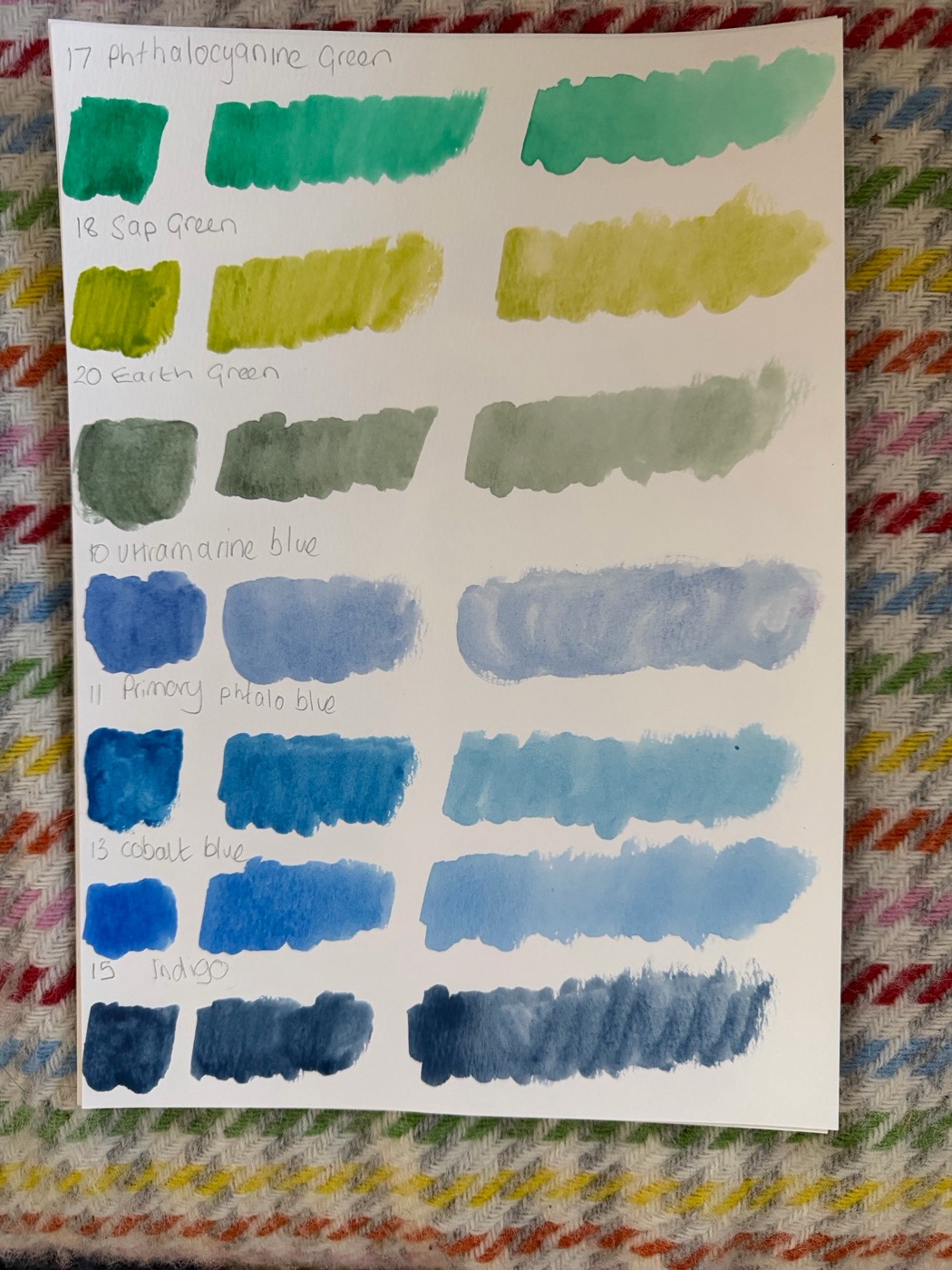
Swatches: greens and blues
Pale ultramarine tint is streaked with white gaps and the indigo breaks into stripes: the brush ran dry mid-stroke. (Lowered 3→2 after a blind second opinion, 14 Oct.)
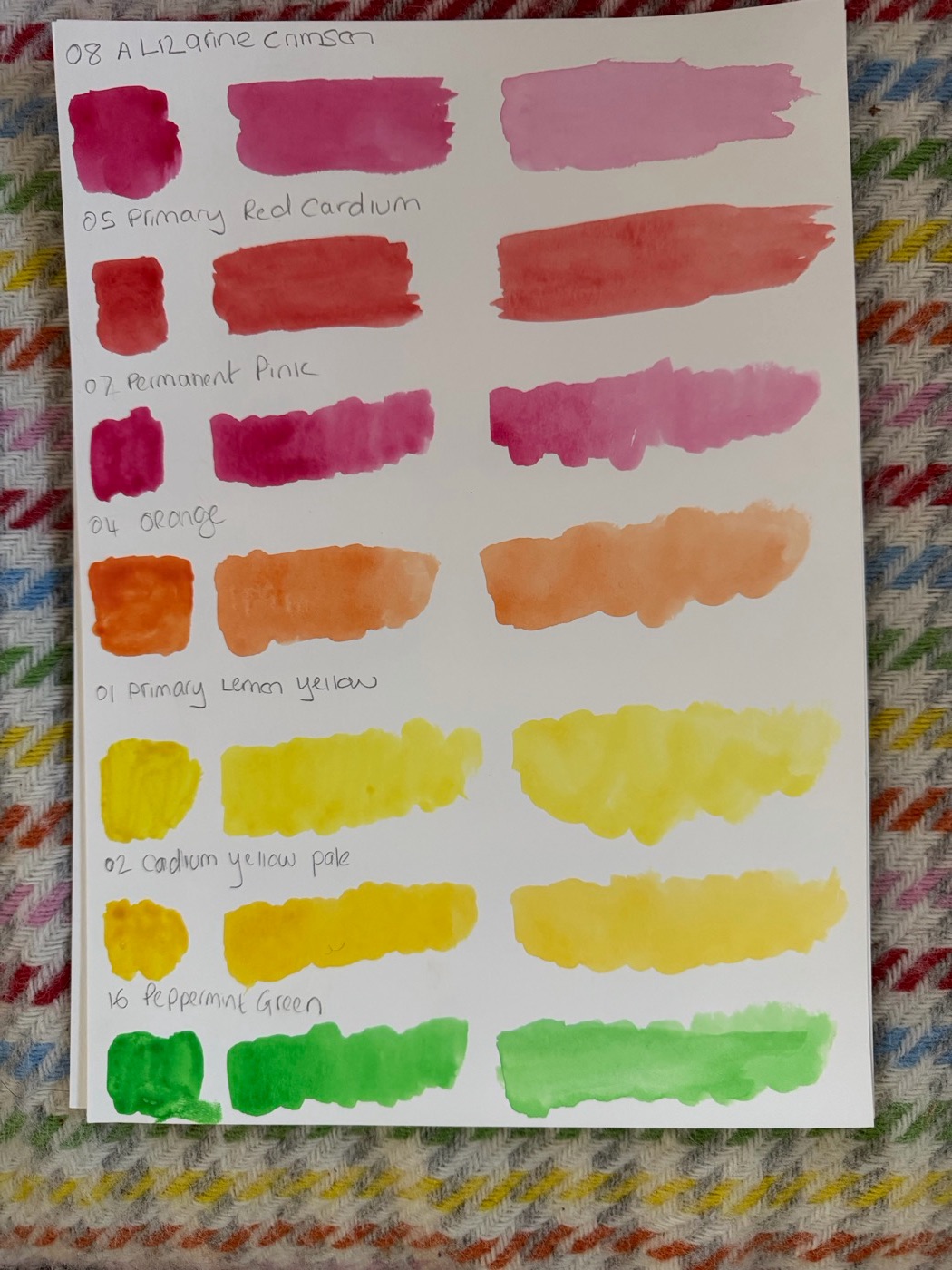
Swatches: reds, oranges, yellows
Cleaner than the other swatch sheets, but the pink and green still band and the lemon yellow has blooms and pooled edges. (Lowered 3→2 after a blind second opinion, 14 Oct.)
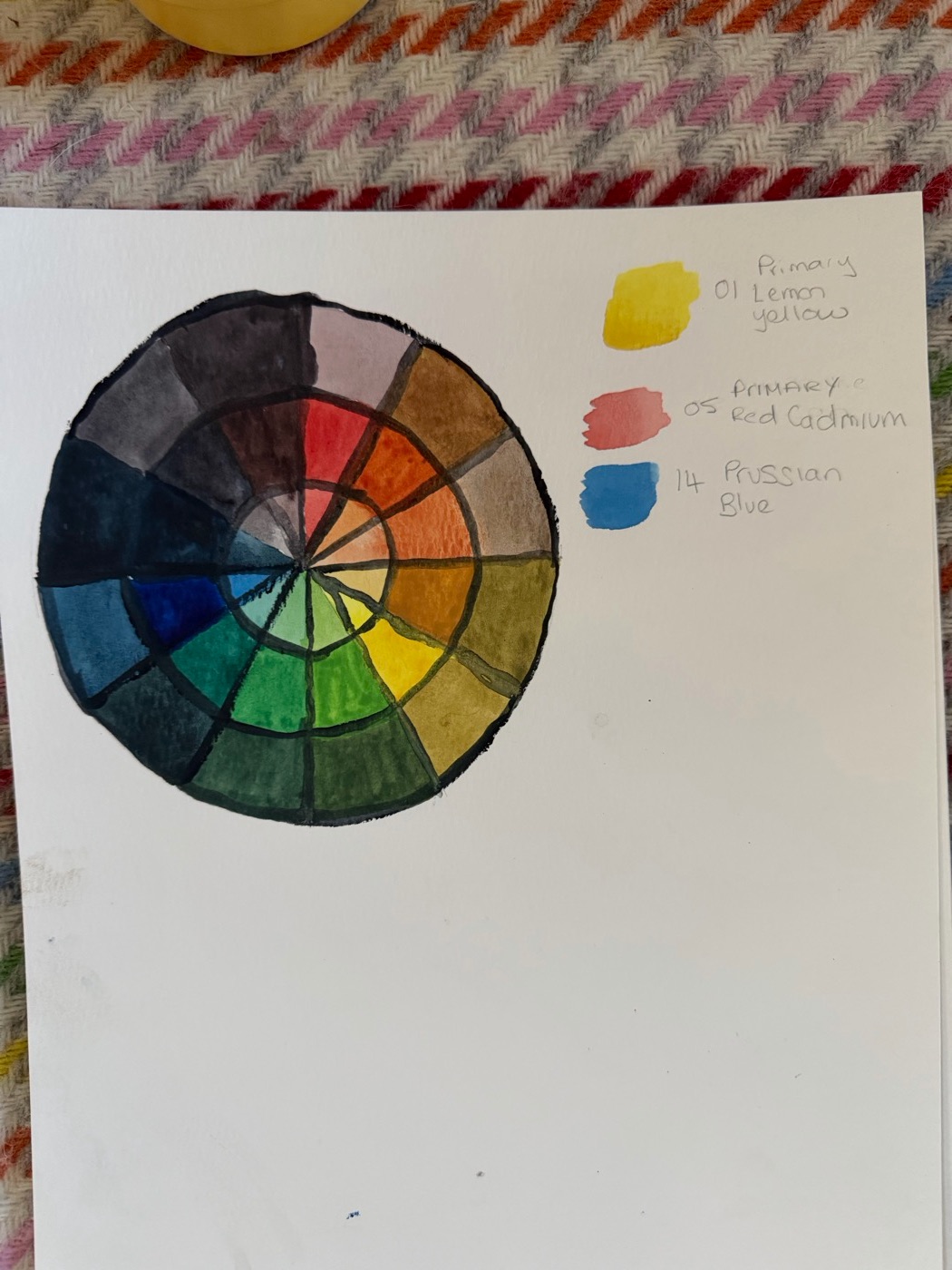
Colour wheel: three primaries, tints and shades
The outer shade ring is blotchy and the painted outlines wobble. (Lowered 3→2 after a blind second opinion, 14 Oct.)
Greens and oranges are clean. Purples went grey-brown (Cadmium Red and Prussian Blue are both biased towards yellow).
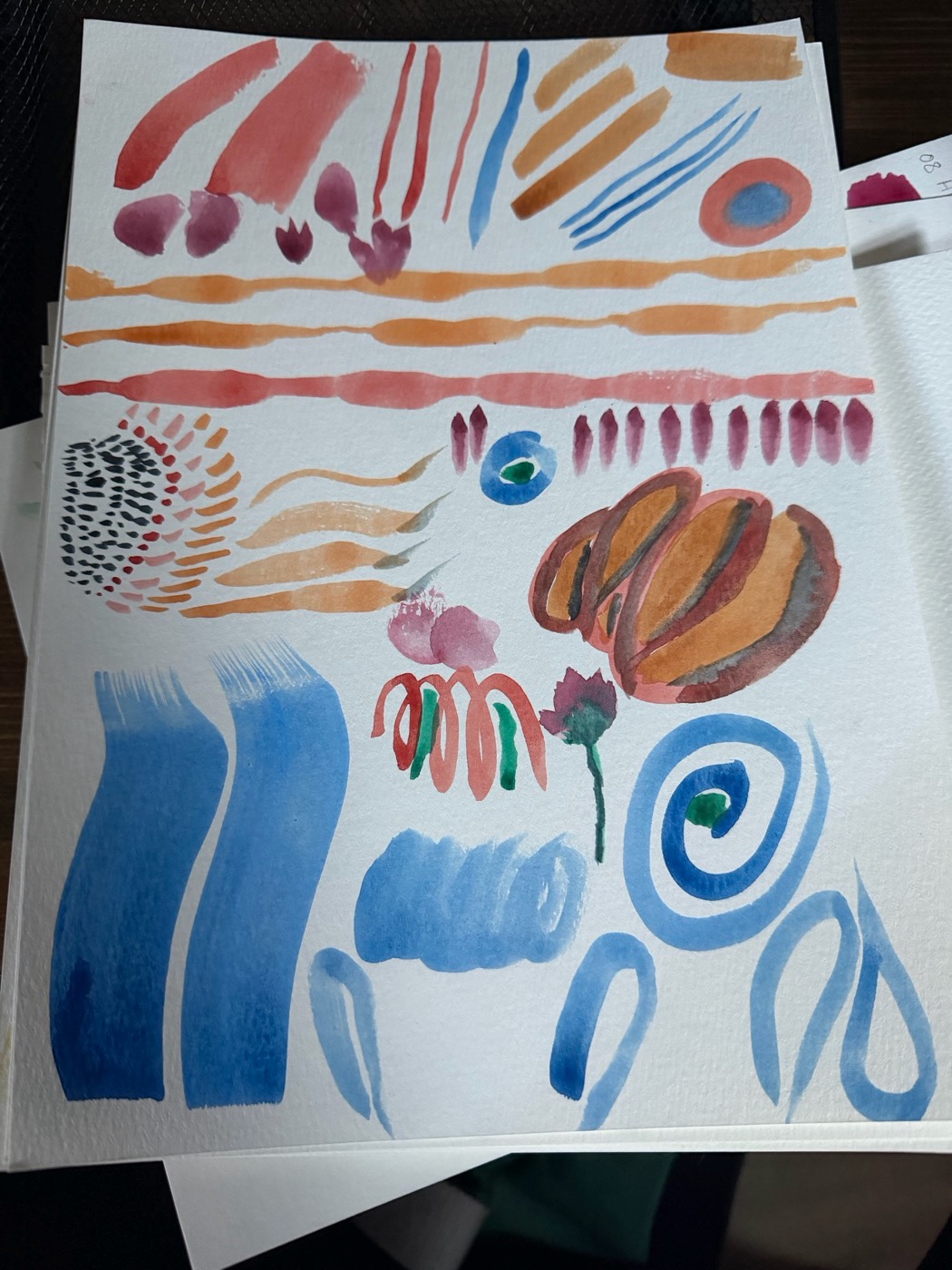
Brush-stroke sheet 1
Confident press-and-lift and dry-brush strokes. Long horizontal lines wobble.
Mostly hard edges. Soft edges appear only where strokes happen to touch while wet.
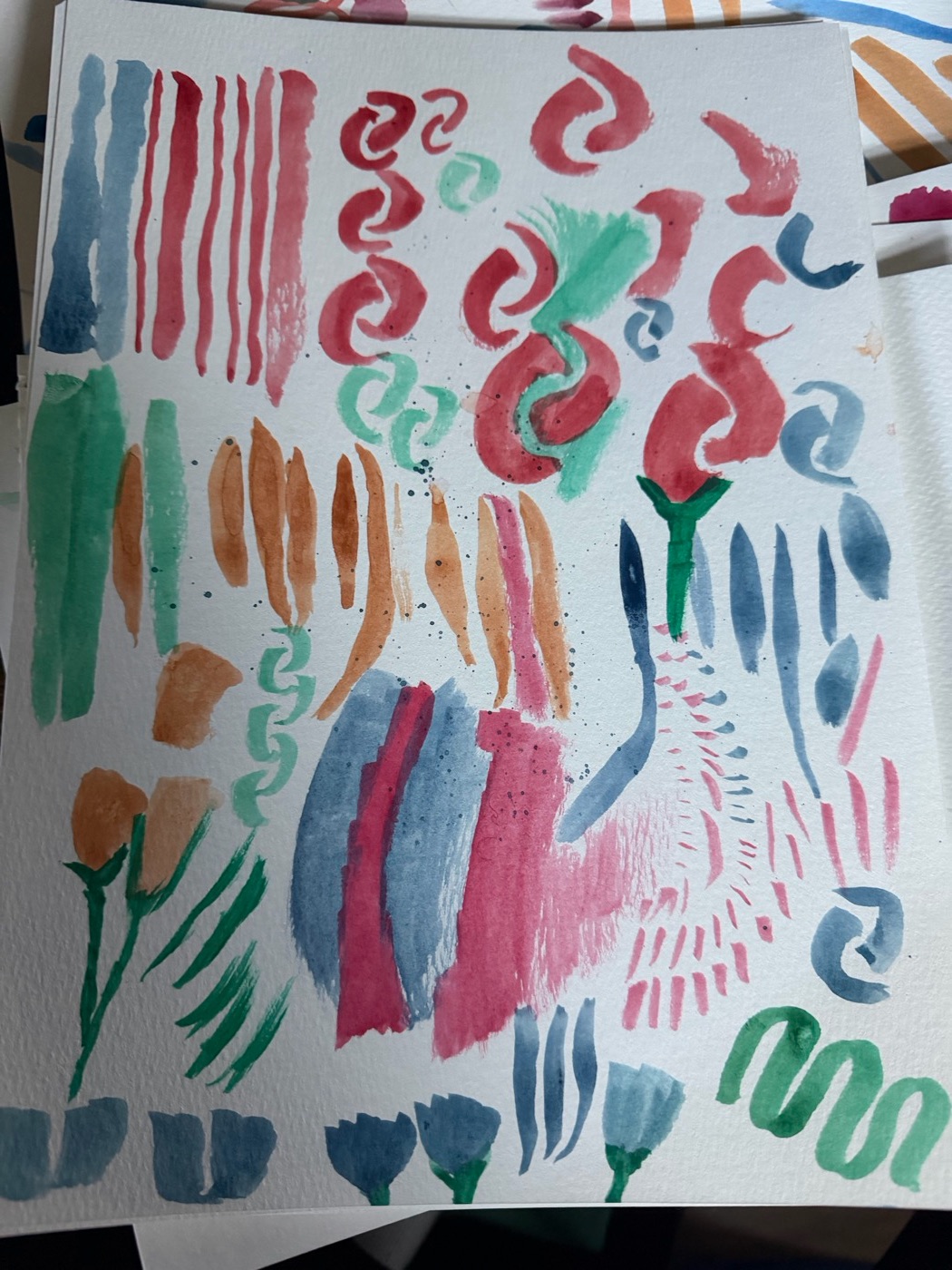
Brush-stroke sheet 2
Varied, controlled marks: chains, petals, splatter.
The blue and red overlap blends softly in places, but by accident.
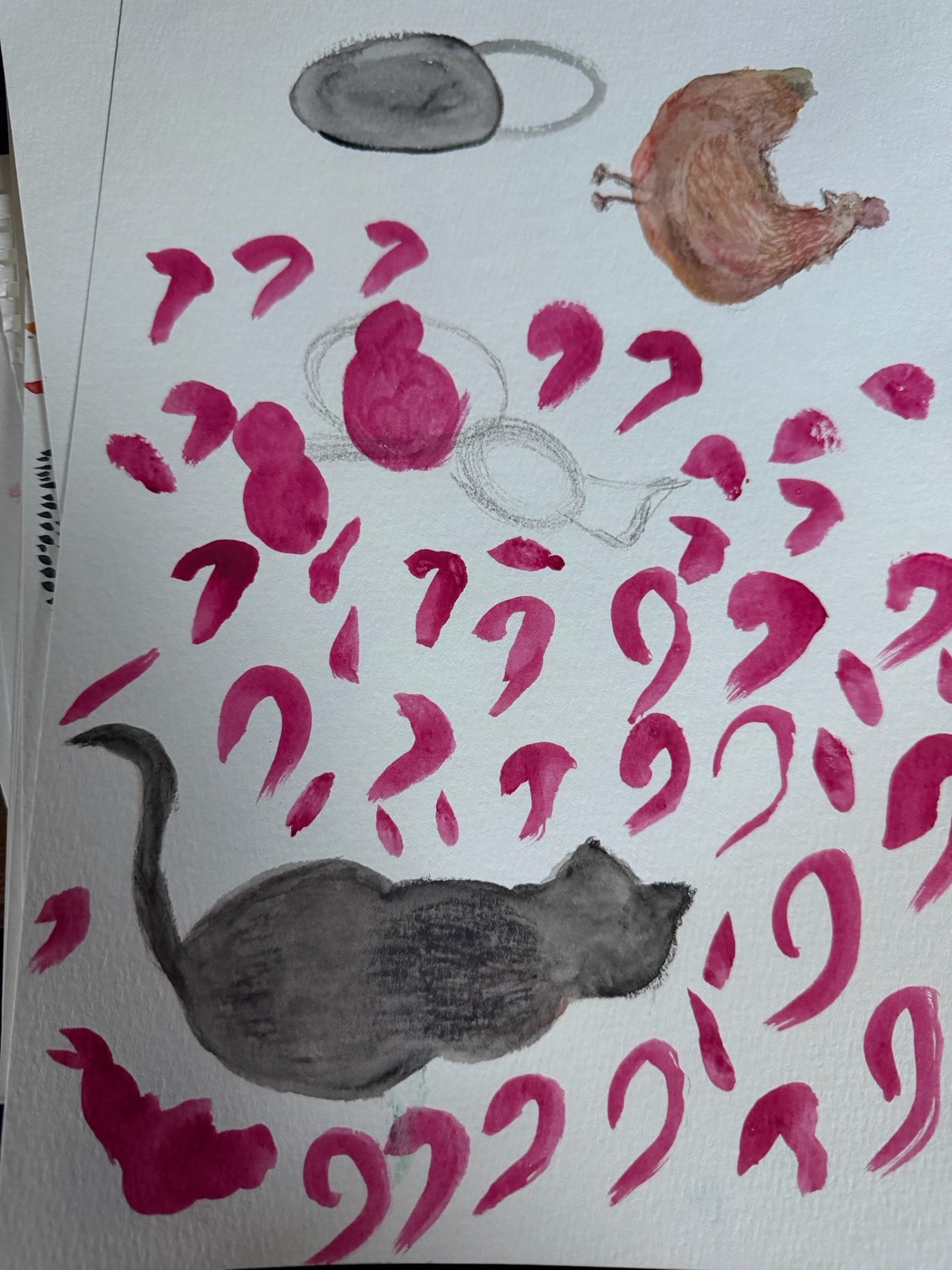
Cat, chicken and magenta strokes
The cat's body is an even flat grey wash.
The cat is one mid-grey: no darker underside or shadow to give it form.
A characterful cat silhouette with a good tail and posture. The chicken's shape reads well.
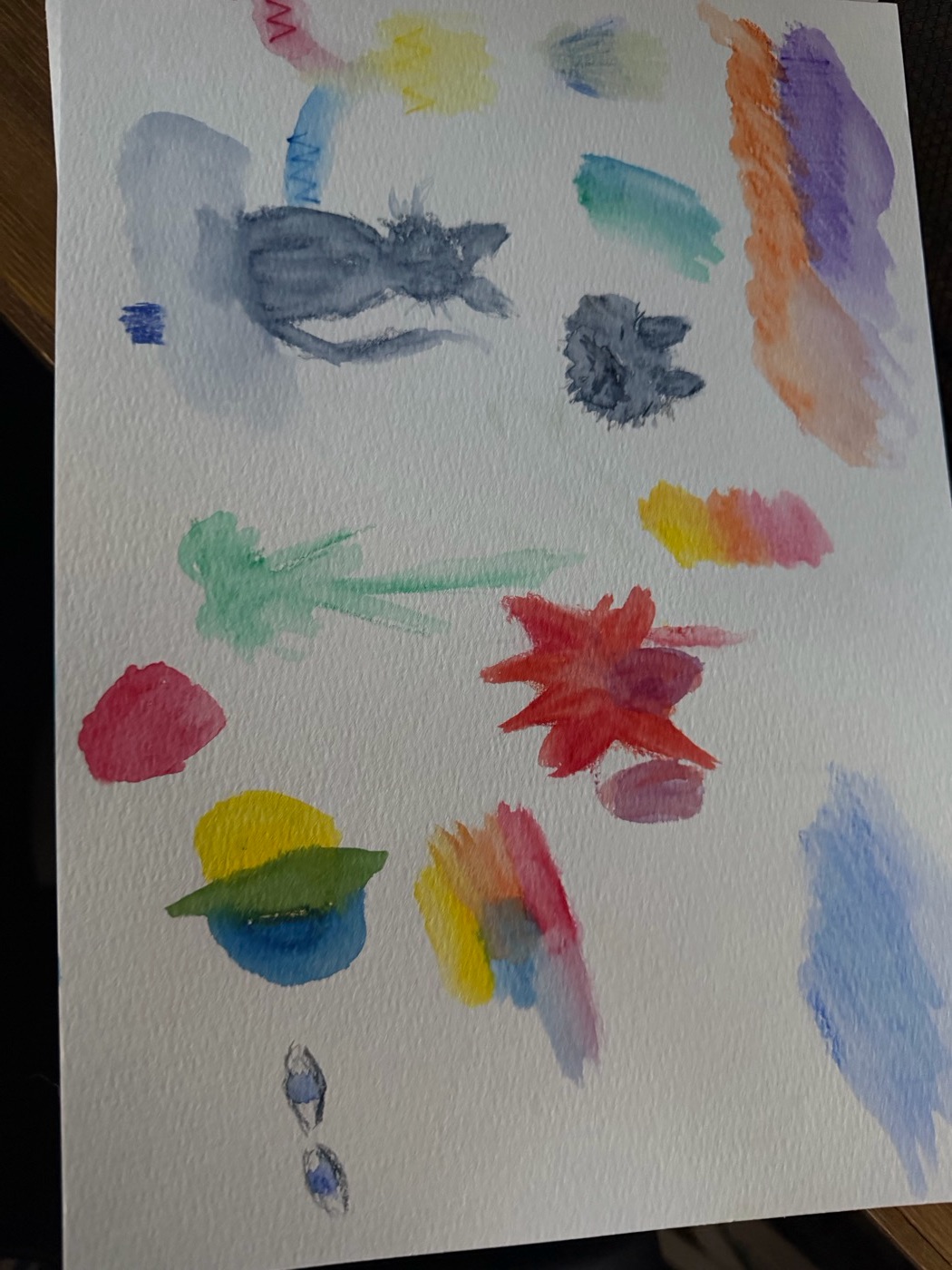
Play sheet: blends, cats, flowers
The purple-orange stripe and blue patch bloom and puddle; the green grass wash is uneven. (Lowered 3→2 after a blind second opinion, 14 Oct.)
Clean yellow → orange → pink and yellow/blue blends, with no mud.
The soft fuzzy cat and the soft-blended gradients look deliberate.
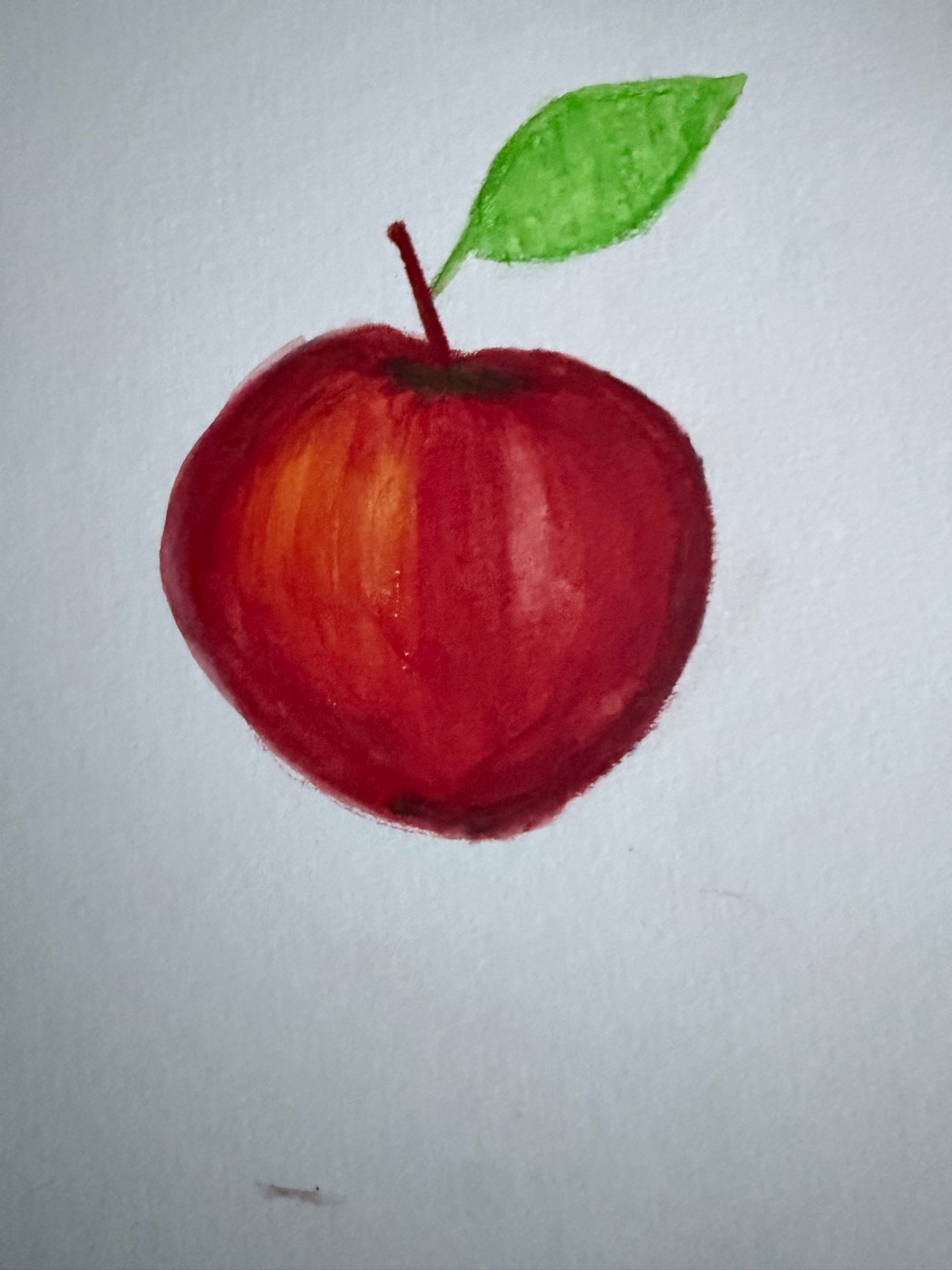
Apple
Reads as round: dark edges, a warm light side and a highlight.
Layered orange → red → crimson on the apple. The leaf is one flat green.
The outline is the same hard edge all the way round. Softening the shadow side would help it turn.
A convincing apple shape and stalk.
It floats: there is no cast shadow or surface.
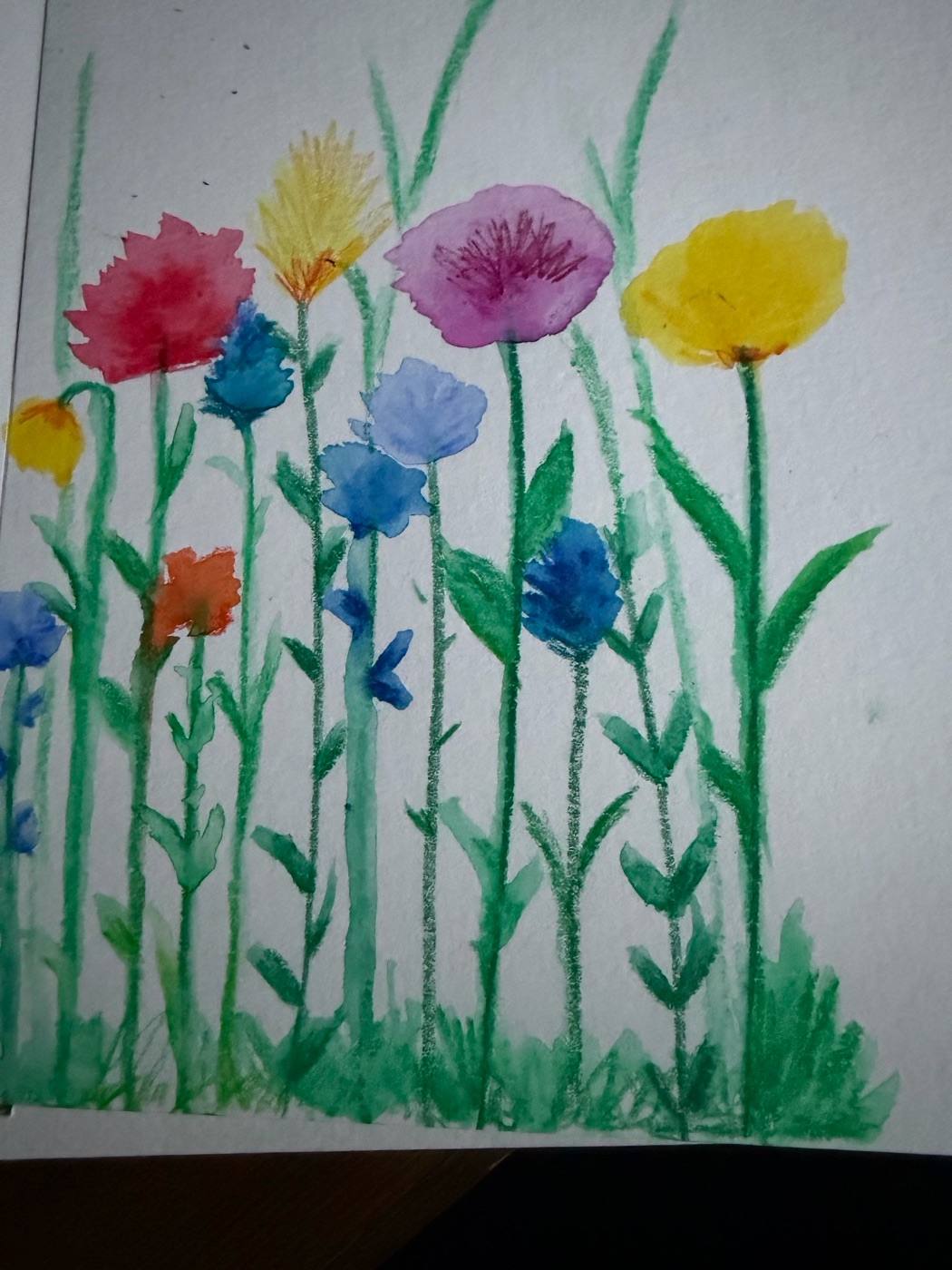
Wildflower meadow
The flower heads are controlled wet-in-wet.
Everything is mid-value: no dark greens at the base or where stems overlap.
Bright, clean flowers, but every stem and leaf is the same green.
Soft blooms in the blue flowers and crisp petal edges on the poppy.
Varied flower types read clearly. The stems are all straight up.
Joyful but evenly spaced: same heights, little overlap, no focal flower.
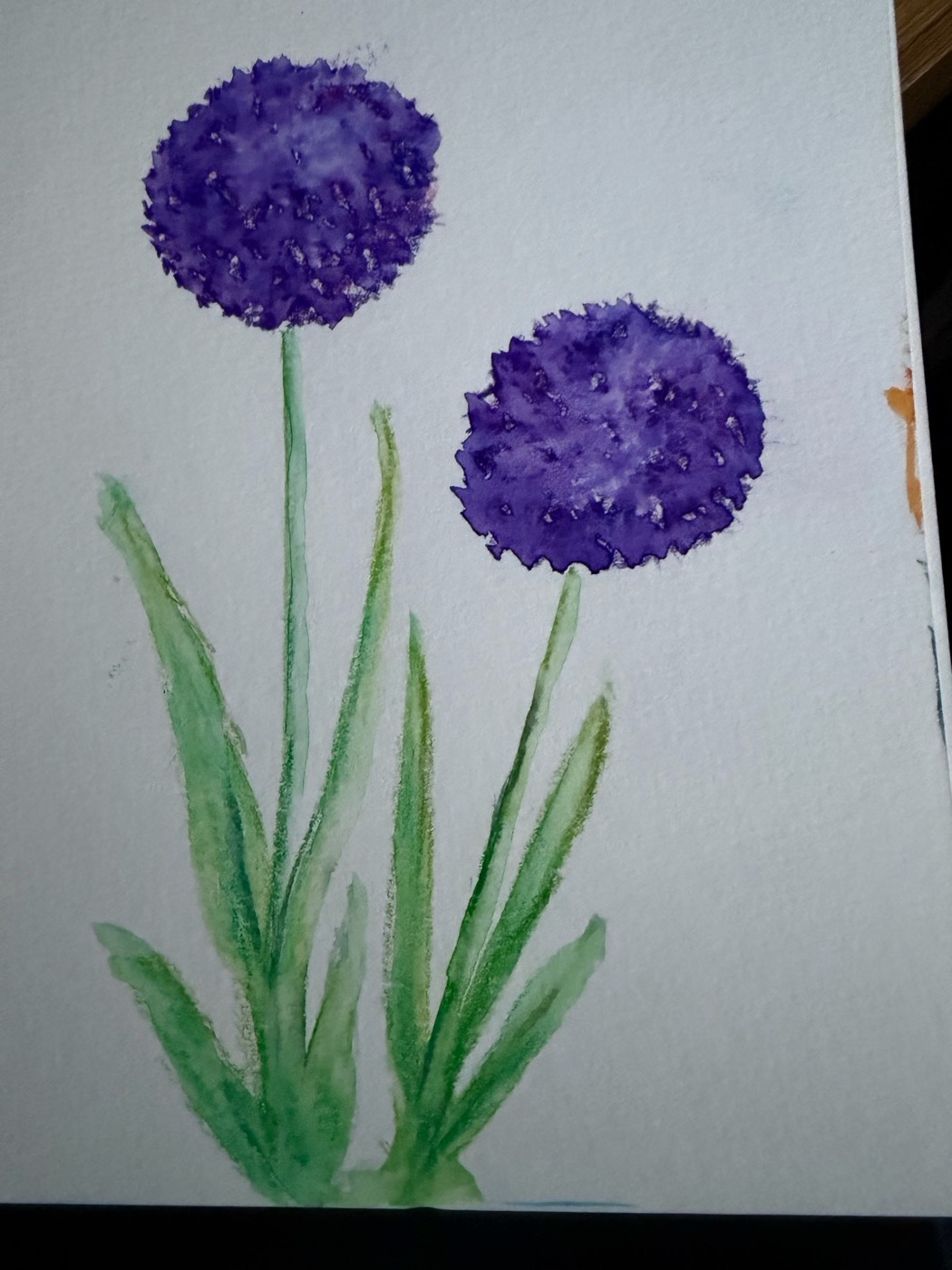
Alliums
The heads are textured with lifted lights: controlled.
Light and dark vary inside each sphere. The leaves are one pale value.
The purple is clean, but the leaves are a single pale green.
Spiky, broken edges on the heads suit the subject.
Good spherical heads, and the leaves taper naturally.
The offset heights and two heads make a clear subject with some variety.